The Three-Check Habit: Riding Taxis and Rideshares Without the Dread
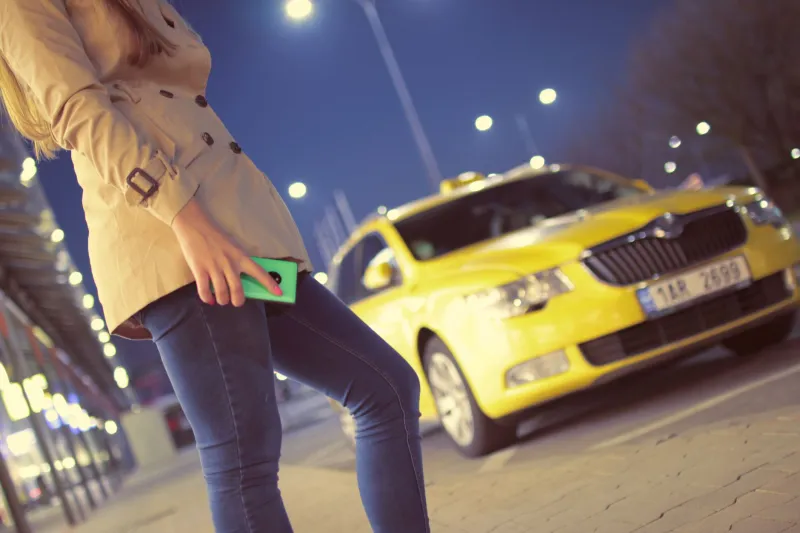
Nobody wants to turn a five-mile ride home into a risk assessment. But most of us get offered only two settings: blind trust, or white-knuckle suspicion of every vehicle with a roof light. Neither is much of a plan.
The middle ground is dull. It's a short routine, run the same way every time, that takes about thirty seconds and doesn't require you to be brave, psychic or rude. Dull is the whole point.
Before the car even pulls up
A bit of paperwork now saves a lot of hedging later.
- Book properly. Private hire vehicles in the UK have to be pre-booked through a licensed operator. Hackney carriages are the ones you can flag down in the street. A car that pulls over and offers you a lift isn't a cab, however convincing the sticker.
- Check the operator is licensed. Your local council publishes a register of licensed drivers and vehicles; in London it's TfL. Thirty seconds on a phone, once, and you know who you're dealing with.
- Match the details. Registration, make, colour, driver's first name, photo. If any one of those doesn't line up, don't open the door. You don't owe anyone an explanation for that.
- Ask, don't assume. "Who are you here for?" gets you the name on the booking. If they say yours and it's wrong, that tells you plenty.
In London you'll also see a private hire licence disc on the windscreen and a driver's badge. Outside the capital, councils run their own versions. Worth a glance.
The seat is a decision, not a default
Get in the back, on the kerbside. That single choice gives you three things at once: the door nearest the pavement, some distance from the driver, and a decent chance of stepping out at a junction without walking into traffic.
If a driver invites you into the front, "I'm grand in the back, thanks" is a complete sentence.
And put the belt on. Every time. It remains the most effective safety decision available inside a moving vehicle, and no amount of situational awareness compensates for it.
Share the trip in a way that actually does something
Live location sharing feels reassuring, but it only works if the person on the other end knows what to do with it. Give them a job.
Send a screenshot of the booking plus a line: "This is my car, reg ending in XYZ, due about 11:20. If I haven't texted by 11:45, ring me. If I don't pick up, ring again."
That's a plan. A silent live pin is a nice extra.
The script for stopping early
Keep two or three lines in your pocket and say them flatly, without the rising apology we're all prone to.
- "Could you pull over at the next safe place, please? I need to get out here."
- "Change of plan — drop me at the next lit stop."
- "This isn't the route I expected. Stop at the next junction, please."
If they ask why, "change of plan" is an entire answer. You are allowed to leave a paid-for journey early. It is not an insult, and it is not a scene.
When the route or the vibe goes sideways
Trust the flat, unglamorous warning signs: the driver ignoring a straightforward instruction, a route that wanders away from the one on your own maps, the central locking clicking when it shouldn't, questions that get too personal, or a sudden decision to skip the stop you asked for.
In that case:
- Keep your voice level. Escalation almost never helps and often makes an exit harder.
- Ask for a busy, well-lit place rather than a quiet one — a forecourt, a supermarket entrance, a pub with people outside. "Anywhere with lights and people" is a good phrase.
- Don't haggle over the fare at the kerb. If you booked through an app, you can settle it after you're out and walking.
- Take your bag with you. Everything else can be sorted later.
When it's more than a bad feeling
If you're in immediate danger, call 999. If you can't speak, call 999 and press 55 when prompted — the silent solution is designed for exactly this. On trains and at stations, text 61016 for the British Transport Police.
Use the in-app safety tools too. The emergency button, the report-a-trip function, the feedback that goes to the operator rather than into the void — that's how drivers get looked at, and eventually removed. Reporting isn't making a fuss. It's the system working the way it's meant to.
The thirty-second debrief
Once you're safely inside, note the registration, the operator, the driver's first name and the time, even if nothing came of it. Patterns matter, and yours is the only record you'll have if something needs following up.
Try it once on a normal night
Run the checks on an unremarkable ride this week — a rainy Tuesday, a five-minute hop to the station, nothing at stake. That's how a routine stops being a performance and becomes a habit, so that at 1am in December it's simply what you do, no adrenaline required.
Confidence isn't a feeling you wait to arrive. It's a short list you run.