Trial, Not Tribute: How to Vet a Self-Defence Class Before You Commit
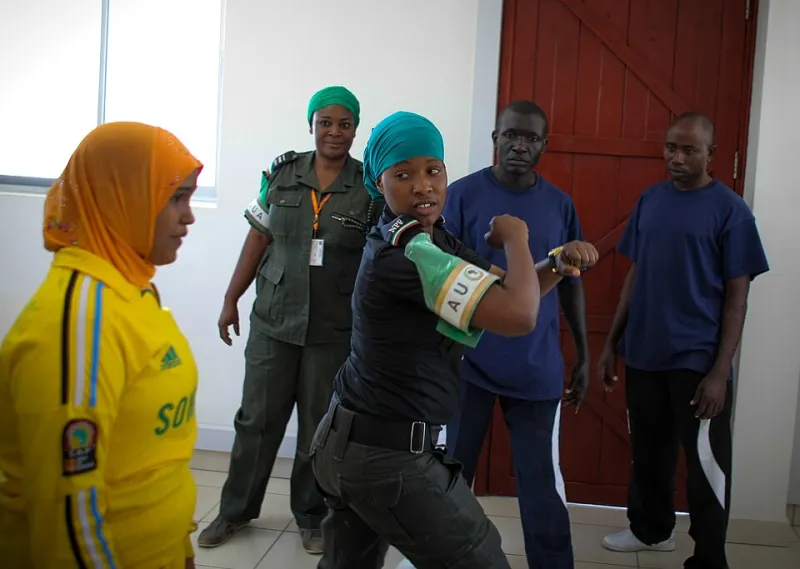
Photo: AMISOM Public Information, CC0, via Wikimedia Commons
Most self-defence courses in the UK are sold as a block. Six weeks, eight weeks, twelve — paid up front, no refunds, and a taster session that feels suspiciously like an audition for the real thing. That's not a reason to avoid classes. It is a reason to treat the first session as a trial rather than a tribute.
You are not there to be impressed. You are there to find out whether the person teaching you can actually teach, whether the syllabus includes anything beyond striking a pad, and whether the room is one you'd be comfortable failing in. Below is how to check, in the order that saves you the most money.
Start with the person, not the poster
There is no single statutory licence for self-defence instructors in the UK, which means the word 'qualified' can mean almost anything. That's not a scandal, it's just a fact you have to work around.
Ask directly, on the phone or by email before you book:
- Which governing body or association are you affiliated with, and can I see the membership number?
- What coaching or teaching qualification do you hold, and when did you last renew it?
- Are you insured for public liability, and does the policy cover self-defence instruction specifically?
- Do you hold a current first aid certificate?
- If you teach under-18s, are you DBS checked?
None of these guarantee a good class. All of them are baseline. An instructor who gets defensive about the questions has told you something useful.
Does the syllabus include the law?
A course that never mentions reasonable force is teaching you choreography, not self-defence. In England and Wales the relevant framework sits in section 3 of the Criminal Law Act 1967 and the common law of self-defence; Scotland and Northern Ireland have their own versions. What matters practically is whether the instructor can explain, in plain English, the difference between force that is proportionate and force that isn't — and whether they'll talk about it without turning it into a scare story.
Ask what happens if you defend yourself and the police are called. A good answer is calm, specific and slightly boring. A bad answer involves the phrase 'you're better off being judged by twelve than carried by six'.
Watch how partners get paired
This is the fastest test in the room. Within twenty minutes you'll know whether consent is treated as a system or an afterthought.
Good practice looks like this: the instructor asks before pairing people, offers the option to work solo or with a bag, checks in when someone says no, and demonstrates how to tap out clearly. Hands-on drills should be introduced with a stated purpose — what you're practising and what you're not.
Red flags are specific. Anyone being told to 'just get on with it'. Pressure to pair with a much larger partner when you've said you'd rather not. Drills that continue after a tap. An instructor who uses shame as a teaching tool, however jokily.
Ask about bodies that aren't twenty-five
A class that only works for fit, uninjured adults is a class with a narrow shelf life. Ask how the drills adapt for a bad knee, a shoulder that dislocates, pregnancy, menopause symptoms, a hijab, a wheelchair, or simply being knackered after a shift.
You're not asking for a special programme. You're asking whether the instructor has thought about it. The answer tends to be either a quick, practical list of modifications or a vague promise that 'we go at your pace'.
The red flags worth walking out on
- Block fees pushed hard on night one, with a discount that expires at midnight.
- No written refund or cancellation policy.
- Claims that you'll 'never be a victim again', or anything that promises certainty about violence.
- Military cosplay — ranks, shouting, punishment press-ups — in a civilian class aimed at beginners.
- Sparring introduced before anyone has taught you to fall.
- No warm-up, no first aid kit, no water, no idea how many people are booked in.
- Being touched without warning, or having your boundaries treated as a joke to be worn down.
- An instructor who can't tell you the last time a student left and why.
That last one is underrated. Ask it. Leavers are data.
What good actually looks like
A well-run UK class is usually small enough that the instructor knows your name by session two. It has a warm-up, a skills block, partner work with clear boundaries, and a wind-down that includes something to think about on the walk home. The instructor demonstrates slowly, then watches, then corrects — rather than performing.
And crucially, it should be slightly dull in the best way. Skill-building is repetitive. If a session feels like a ritual you've been permitted to attend, you've probably paid for atmosphere rather than ability.
A three-step trial plan
- Watch before you join. Many instructors will let you observe a session for free. Sit at the back. Notice how the quietest person in the room is treated.
- Do one paid session with no commitment. Say plainly: 'I'm not deciding on the block tonight.' A good school will be completely fine with that.
- Sleep on it, then ask one follow-up question by email. How they handle admin tells you how they handle everything else.
You are buying a skill, not joining a tribe. Take the trial. Skip the tribute.