Hands Full, Head Clear: Dark-Morning Dog Walks Without the Freeze
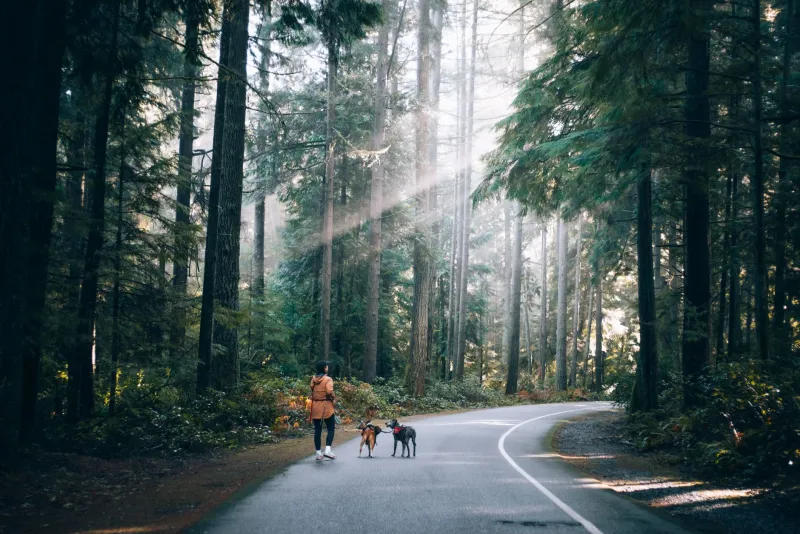
Dark mornings have a way of making a familiar pavement feel like someone else’s. The dog still needs out. You still have a life to get to. And somehow you are meant to manage a lead, a torch, a treat pouch and a vague sense that the person ahead is walking a bit too slowly. This is not a guide to staying indoors until sunrise. It is a plan for walking with your hands full and your head still clear.
Start with kit that leaves you one useful hand
The best dog-walking setup for low light is the one you can operate without a debate at the front door. A fixed-length lead of around 1.5 to 2 metres, ideally with a second traffic handle near the collar, gives you quick control without yards of cord to gather. Retractable leads have their fans, but in the dark they are a lot of moving parts: a lock to fumble, a thin line to spot, and a dog who can be several metres away before you have clocked the cyclist. Save the long line for daylight sniffing.
A well-fitted harness with a sturdy handle is worth its weight. It gives you something to hold if you need to steady your dog at a kerb or guide them close while you step aside. Pair that with a head torch or a small hand torch on a wrist strap, high-vis for the dog and something bright on you. Reflective strips on ankles and cuffs work better than a single fashionable flap that disappears under a coat.
Keep the small stuff clipped to you, not buried in a bag: poo bags, keys, a phone in a zipped pocket. A treat pouch on your waist leaves one hand freer. If you use a hands-free belt, practise clipping and unclipping in daylight until it is boring. The point is not to look tactical. The point is to avoid the thirty-second dance of swapping lead, torch and phone while your dog wraps you to a lamp post.
Pick routes for exits, not just scenery
Most of us walk the same loops because they work. That is fine. The useful habit is knowing where the exits are. On your normal route, mentally mark three places you could step into or turn towards: a bright garage forecourt, a bus stop with people, a shop doorway that is open early, a neighbour’s gate you could knock on. You are not building a bunker map. You are giving your brain options before it needs them.
In low light, favour the pavement side away from dark alley mouths and overgrown cut-throughs, but do not get rigid about it. A quiet road with streetlights and clear sightlines often beats a shortcut through a park with one working lamp. Cross at crossings where drivers expect you, and make eye contact with the driver before you step. Your dog may be high-vis, but a driver half asleep at 6.40am is not scanning for a wagging tail.
Vary the route occasionally, not because routine is dangerous, but because knowing two or three ways home keeps you flexible. If something feels off, you want to be able to turn left without wondering where left goes.
Make voice commands your first distance tool
A dog who responds to a few clear words gives you a second pair of ears and a way to move as a unit. Practise in daylight, with treats, when nothing is happening. “Wait” at kerbs. “Close” when you want them beside you. “This way” for a brisk change of direction. “Leave it” for the chip wrapper, the discarded kebab, the other dog’s ball. Keep your tone bright and ordinary. Shouting turns a small moment into a scene.
Voice commands also do something subtler: they signal to anyone nearby that you are awake, aware and not drifting. A person who is muttering “close, good girl, this way” while walking purposefully is a less appealing target than someone staring at a phone with a lead looped loose around their wrist. You are not performing confidence. You are practising it.
When a stranger makes the pavement feel wrong
Trust the early twinge. You do not need a full risk assessment before you cross the road. If someone ahead is lingering, if a van has stopped oddly, if footsteps behind you are matching your pace, make one clear move: cross, turn, step into a brighter spot, or go into the shop. You do not owe a stranger a polite explanation for changing direction.
Keep the lead short and your dog close, but do not deliberately position the dog between you and someone else as a barricade. That can escalate things and puts your dog in the middle. Instead, create space sideways. Step off the pavement into a gateway if it is safe, put a parked car between you, or turn and walk back the way you came. A firm “we’re not stopping” or “keep going” is enough if someone tries to chat. You are not being rude. You are being unavailable.
A torch is for seeing and being seen, not for dazzling people. A brief sweep of light towards a dark doorway is sensible. Shining it in a stranger’s face tends to start a fight rather than end one. And despite what adrenaline might suggest, a lead is not a weapon. UK law allows reasonable force in self-defence, but swinging a dog lead is more likely to unbalance you and frighten your dog than solve the problem. Distance, voice and an exit are the tools to rehearse.
When the other dog is the issue
Another dog off-lead in a shared space is its own kind of morning. You cannot control the other owner, but you can control your distance. Turn before you are close enough for a nose-to-nose meeting. Step behind a parked car, into a driveway, or onto the road if it is clear and safer than the pavement. Ask the other owner to call their dog, but do not wait for them to become a responsible person in real time.
Keep your lead short and your body calm. If your dog is small, picking them up is a judgement call: it can protect them, but it can also make you a stationary target and make the other dog more interested. If your dog is large, a short lead and a confident turn away is usually better than a tug-of-war. Report repeated problems to the council or the park warden if it is a known spot. You are allowed to be the person who keeps a note.
The thirty-second reset
If you feel the freeze coming, plant your feet for a moment. Breathe out longer than you breathe in. Name three things you can see: the bus shelter, the blue bin, the crack in the pavement. Then choose one action: cross, turn, knock, call. The freeze is not a character flaw. It is a nervous system doing too much at once. Giving it a small, concrete task brings you back into the walk.
On the way home, notice what worked. Did the traffic handle help at the kerb? Did “this way” get you out of an awkward chat? Tell someone where you went if you are walking in the dark, and share your location if that feels useful. The aim is not to walk in fear. It is to walk with your hands full, your dog steady, and your head clear enough to choose the next move.